 Marika
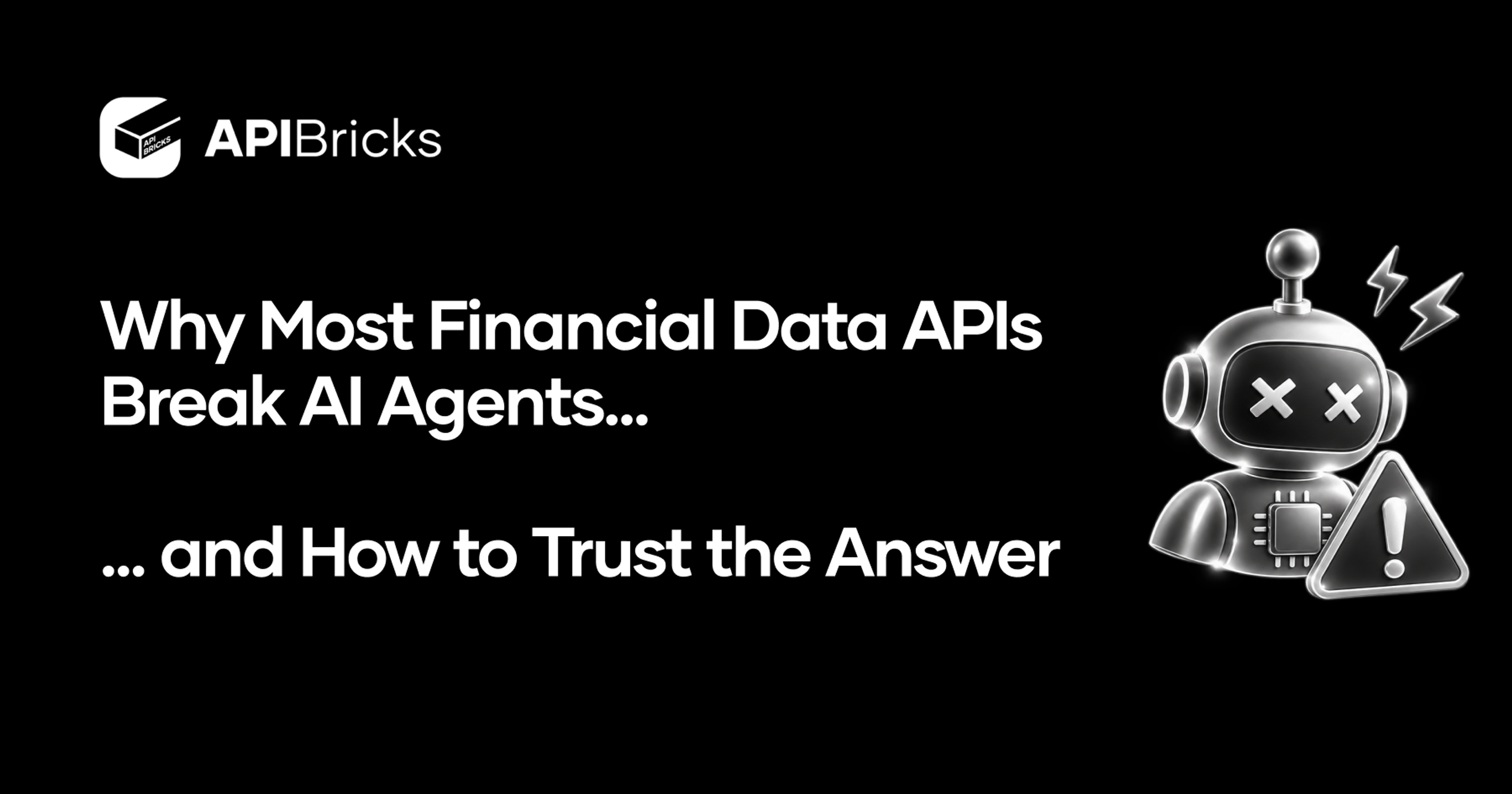
A financial AI agent can retrieve accurate data and still produce incorrect conclusions. The problem is not always the model. Often, it is the way financial data is structured, timestamped, identified, and combined.
When AI agents work across cryptocurrency markets, historical equities, SEC filings, and prediction markets, differences in data semantics become particularly important.
Connecting an LLM to financial data APIs or MCP servers solves data access. It does not automatically solve data interpretation, historical accuracy, or validation.
1. Schema Incompatibility: Valid JSON Is Not Enough
Financial APIs can return similar field names while describing fundamentally different financial objects.
A cryptocurrency trade price, an equity closing price, and a prediction market outcome price all represent different information. An AI agent cannot interpret them interchangeably simply because each response contains a price field.
| Dataset | Essential context |
| Crypto market data | Exchange, instrument type, base and quote assets |
| Historical equities | Trading session, exchange, price adjustment methodology |
| SEC filings | Reporting period, publication date, accounting units |
| Prediction markets | Contract conditions, outcome, resolution rules |
| Exchange rates | Currency pair, calculation methodology |
Even when datasets come from the same provider, their schemas are not necessarily identical.
A reliable financial AI system needs an application-level normalization layer that standardizes common metadata while preserving dataset-specific financial semantics.
2. Timestamp Misalignment: The Wrong Sequence of Events
Financial data operates across multiple temporal dimensions. The time an event occurred, the time it was published, and the time it became available to an application are not necessarily the same.
| Timestamp | Meaning |
| Event time | When the financial event occurred |
| Provider time | When the provider recorded or processed the event |
| Publication time | When information became public |
| Availability time | When data became accessible to the application |
| Retrieval time | When the agent obtained the data |
For example, CoinAPI cryptocurrency market data distinguishes between time_exchange and time_coinapi. Sorting trades by the wrong timestamp can change the reconstructed sequence of market activity.
Similarly, an SEC filing published after stock market hours cannot be immediately evaluated against a subsequent regular-session stock price reaction.
Converting timestamps to UTC solves formatting inconsistencies, not differences in temporal meaning.
3. Incompatible Identifiers: Analyzing the Wrong Financial Instrument
Financial identifiers are not universal. The same cryptocurrency can trade across multiple exchanges and instrument types, while a company may have several listings or share classes.
AI agents must distinguish between exchange IDs, symbol IDs, SEC CIKs, filing accession numbers, and prediction market IDs.
For example, connecting an SEC filing with historical stock prices requires mapping the reporting entity to the correct traded security. Similarly, two prediction market contracts referencing the same event may have different resolution conditions.
Reliable financial AI requires explicit entity resolution rather than simple name or ticker matching.
4. Missing Historical Context Leads to Incorrect Analysis
Historical financial data is only useful when the agent understands its context.
- Equities: A stock split can be misinterpreted as a significant price decline.
- Crypto: Missing order book updates can distort historical liquidity calculations.
- Prediction markets: Outcome prices can be misinterpreted without contract conditions and lifecycle information.
- SEC filings: Financial restatements can change previously reported figures.
Historical data quality is not simply about coverage. It is about preserving the financial context necessary to interpret each observation correctly.
5. Point-in-Time Accuracy and Look-Ahead Bias
Point-in-time accuracy ensures that financial AI agents use only information available at the moment being analyzed.
Imagine an agent evaluating a company as of July 15. Its quarterly reporting period ended on June 30, but the results were not published until August 5. Including those results in the July analysis introduces look-ahead bias.
The same problem occurs when agents use unfinished cryptocurrency candles, historical T+1 equity data in simulated same-day decisions, or subsequently resolved prediction market outcomes.
Historical data availability does not automatically guarantee point-in-time accuracy. Developers must distinguish event timestamps from publication and availability timestamps, enforce research cutoffs, and account for subsequent revisions.
6. Financial Data Validation Before AI Reasoning
A reliable financial AI architecture introduces a validation layer between data retrieval and model reasoning.
Before passing financial data to an LLM, the application should verify:
- Schema compatibility and financial units
- Instrument and entity identifiers
- Timestamp consistency and point-in-time eligibility
- Missing observations and duplicate records
- Source provenance and numerical accuracy
Calculations and validation should rely on deterministic application logic. The model should focus on interpreting verified evidence, identifying relationships, and explaining findings.
When data is incomplete, the agent should communicate uncertainty instead of generating unsupported conclusions.
7. Why MCP Alone Does Not Solve Financial Data Quality
Model Context Protocol (MCP) simplifies how AI agents discover and retrieve financial data. However, standardized tool access does not guarantee standardized financial meaning.
MCP does not automatically resolve instrument identities, prevent look-ahead bias, align timestamps, or validate historical observations.
Production-ready financial AI systems still require application-level normalization, evidence management, and output validation.
MCP solves tool connectivity.
Financial data engineering solves analytical reliability.
8. Building Reliable Financial AI Infrastructure with API Bricks
API Bricks connects complementary financial datasets through two specialized platforms:
- CoinAPI: cryptocurrency trades, quotes, order books, OHLCV, exchange rates, and historical datasets.
- FinFeedAPI: historical equities, structured SEC filings, prediction market data, and foreign exchange rates.
Both platforms provide structured API access, dedicated MCP servers for supported products, and historical data delivery options.
Developers can build multi-source financial AI applications within a common provider ecosystem while preserving dataset-specific identifiers, timestamps, and financial semantics.
Better Financial AI Starts with Better Data
A more powerful LLM cannot compensate for incorrect timestamps, ambiguous instruments, or missing historical context.
The reliability of financial AI agents depends on the quality of their data infrastructure and the validation processes surrounding it.
Explore API Bricks, start with $25 in free credits, and build your next financial AI application on structured, traceable financial data.
Related Topics
- How Do Subscriptions, Committed Plans, Usage Credits, Auto-Recharge, and Overages Work Together?
- Building Better AI With CoinAPI and FinFeedAPI
- Why Most Financial Data APIs Break AI Agents
- REST, WebSocket, or Flat Files S3?
- How to Build a Multi-Asset Data Stack That Actually Scales
- Build vs Buy vs Custom Integration
- Why Most Financial Data APIs Break AI Agents